
How to record symptoms without relying on memory
A useful symptom note is a small snapshot, not a diagnosis. Record what you noticed while it is reasonably fresh, add the time and context that may help you remember it, and leave conclusions about cause or treatment to a qualified healthcare professional.
Record the observation while it is reasonably fresh
Memory tends to compress a day into a general impression. A short note made near the event can preserve details that are difficult to reconstruct later: the start time, duration, location, and what you were doing. You do not need to interrupt everything to write a long entry; a few accurate words are enough.
If you add the note much later, say so when the timing is uncertain. “Started sometime after lunch” is a more dependable record than an invented minute-by-minute timeline.
Use consistent, plain descriptions
Describe the experience in words you will understand later: “dull headache,” “nausea after dinner,” or “lightheaded when standing.” Avoid choosing a diagnosis as the label unless a qualified professional has already given you that diagnosis and you are clearly recording it as part of your history.
MedlinePlus suggests noting what a symptom feels like, when and where it appears, how long it has been present, and whether it has changed when preparing for a medical visit. Those same details can make a routine note easier to review.
Record time and context without overloading the note
Context answers simple questions: What time was it? What were you doing? Had you eaten? Were you traveling or following an unusual schedule? Include only details you directly observed and think may be useful later.
- Date and approximate start time
- Duration or end time, when known
- Where in the body you noticed it
- Activity or routine context
- Whether the observation changed or repeated
Separate observations from assumptions
Observation
“Nausea began around 3 p.m. and lasted about 40 minutes.” This describes the experience and timing.
Context
“I had eaten lunch about two hours earlier.” This preserves another fact without deciding that it explains the symptom.
Assumption
“The medication caused the nausea.” A routine log cannot establish this. If you wonder whether observations may be connected, write the question and bring it to a qualified healthcare professional.
If you use a severity scale, use it the same way each time
A personal scale can help you compare your own entries, but only if the anchors remain stable. You might use words such as mild, moderate, and severe, or a number scale with a short definition for its endpoints. Pick one approach and keep it consistent.
A number is not a clinical assessment by itself. Add a plain description when it helps: whether the symptom interrupted sleep, changed an activity, or faded without affecting the day. Do not compare your personal score with someone else’s as though the numbers have identical meaning.
Review patterns without claiming causation
After several entries, you may notice repeated timing or context. Describe the pattern modestly: “three notes were recorded in the evening” or “the symptom appeared twice during travel.” A chart or sequence can help you remember what to discuss, but it cannot determine why the pattern occurred.
Keep alternative explanations open and bring concerning or persistent observations to a qualified healthcare professional. Do not use a trend in an app to start, stop, delay, repeat, or change medication.
Know when the app is the wrong tool
A symptom log is for organization; it is not an emergency service and it does not monitor you. If a symptom is new, worsening, concerning, or may require prompt attention, contact a qualified healthcare professional or the service they direct you to rather than waiting to see what an app trend shows.
If you think a problem is life-threatening, MedlinePlus advises calling 911. Do not delay emergency help to finish an entry, search your history, or wait for an app response.
How Shotz keeps observations usable
Symptom notes stay beside the routine, not above it.
Shotz lets you record a symptom, severity, and optional note, then review those entries near weight and dose context. It does not diagnose a symptom, determine its cause, or monitor for emergencies.
See the related Shotz feature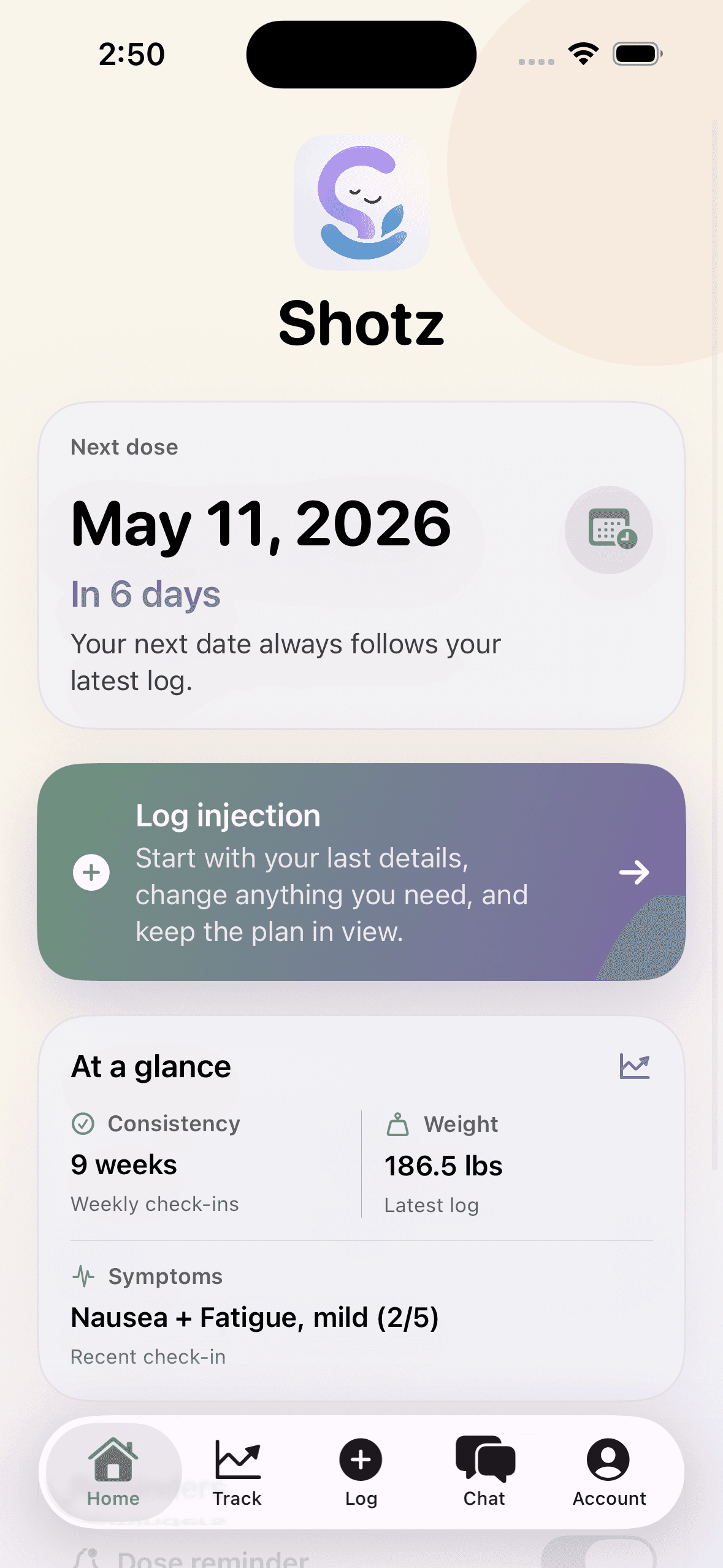
Keep the routine together in Shotz.
Plan, log, and review your routine in one considered iPhone and iPad app.
Download on the App StoreResearch
Sources
Authoritative sources were opened and checked against the health-related statements they support. Product descriptions come from the current Shotz interface and site implementation.
- 1. Make the most of your doctor visit — MedlinePlus, U.S. National Library of Medicine. Recording descriptive symptom details such as when and where symptoms appear, duration, and change over time.
- 2. Emergency Medical Services — MedlinePlus, U.S. National Library of Medicine. Seeking emergency care and calling 911 when a problem may be life-threatening.
Editorially reviewed for clarity, sourcing, product accuracy, and medical boundaries. This article is not medical advice. Read the Shotz Editorial Standards or request a correction at simon@shotzapp.app.
Continue reading
Related guides
How to prepare a medication log for an appointment
A practical way to review a personal medication log, separate recorded facts from observations, and organize questions before a healthcare appointment.
Published August 11, 2026 · 4 min read
ChecklistA weekly injection-record checklist
A concise, printable-feeling checklist for recording a weekly injection event accurately—without dosing or administration instructions.
Published August 11, 2026 · 4 min read