
What to include in a GLP-1 dose log
A useful dose log does not need to be exhaustive. It needs to make the basic facts easy to enter, easy to understand later, and easy to distinguish from your own observations. Here is a calm structure you can adapt to the routine you already follow.
Start with what happened—not what was planned
A dose plan and a dose history answer different questions. The plan describes the routine you intend to follow. A log entry records what actually happened. If the date, time, or user-recorded dose differed from the plan, the history is most useful when it reflects the event rather than silently copying the plan.
This distinction also keeps the log in its proper role. A personal log can help you remember and organize information, but it does not direct your treatment and it does not replace the medication list or clinical record maintained by your healthcare professionals.
The core fields of a dose entry
Medication name
Record the medication name clearly enough that you can recognize it later. This matters especially if your routine changes over time or if you keep more than one medication record. The FDA includes the name of each medicine among the basic details in a current personal medication list.
Dose as you recorded it
Enter the dose that reflects your own record of the event. Copy the units carefully and use the same form from entry to entry when possible. A dose log should never calculate, recommend, or adjust a dose for you; questions about what amount to use belong with a qualified healthcare professional and the official instructions for your medication.
Date and time
Use the date and time the event occurred, not simply the moment when you remembered to open the app. If you add an entry later, take a moment to check the date before saving it. That small check protects the order of the history and makes later review less confusing.
Injection site, if you choose to record it
A site field can preserve a detail you already know and want in your history. It is optional recordkeeping—not a recommendation about where to inject. Follow the instructions supplied with your medication and the guidance of your healthcare professional for administration questions.
Add context only when it will help later
Routine notes are most useful when they capture a specific detail that could otherwise be forgotten. A note such as “recorded after evening meal” preserves context. A vague note such as “different today” may be harder to interpret a month later.
Weight and symptom check-ins can be kept near the dose history when you want to review the same period. They should remain observations in their own right. Their proximity to a dose does not establish that the medication caused a change.
- Keep the wording short enough that you will actually use it.
- Record a symptom in plain language rather than trying to diagnose it.
- Include time or context when it changes the meaning of the note.
- Leave an optional field blank when you have nothing useful to add.
Why consistent field names make a history easier to review
Consistency reduces the work of comparing entries. If one entry calls a field “time,” another “taken at,” and a third buries the time in a note, reviewing the sequence becomes a small decoding exercise. Stable labels let your attention stay on the information.
The same principle applies inside free-text notes. You do not need rigid language, but repeated descriptions help. If you use a personal severity scale, keep its meaning consistent instead of changing the anchors from week to week. If a description was mistaken, correct the entry rather than adding a second competing version when the app allows it.
A 20-second review before you save
The goal is not a perfect diary. It is a dependable record that asks little of you in the moment and gives useful context back when you return to it.
- Is the medication name clear?
- Does the dose and unit match what you intended to record?
- Are the date and time about the event itself?
- Are optional notes factual and understandable without extra context?
- Does the entry describe what happened without turning the log into treatment advice?
How Shotz organizes an entry
The routine fields stay together.
Shotz lets you record medication, dose, date, time, and an optional injection site in one flow. Weight and symptom check-ins can be added separately or alongside a dose, and recent entries can be revisited when a detail needs correcting.
See the related Shotz feature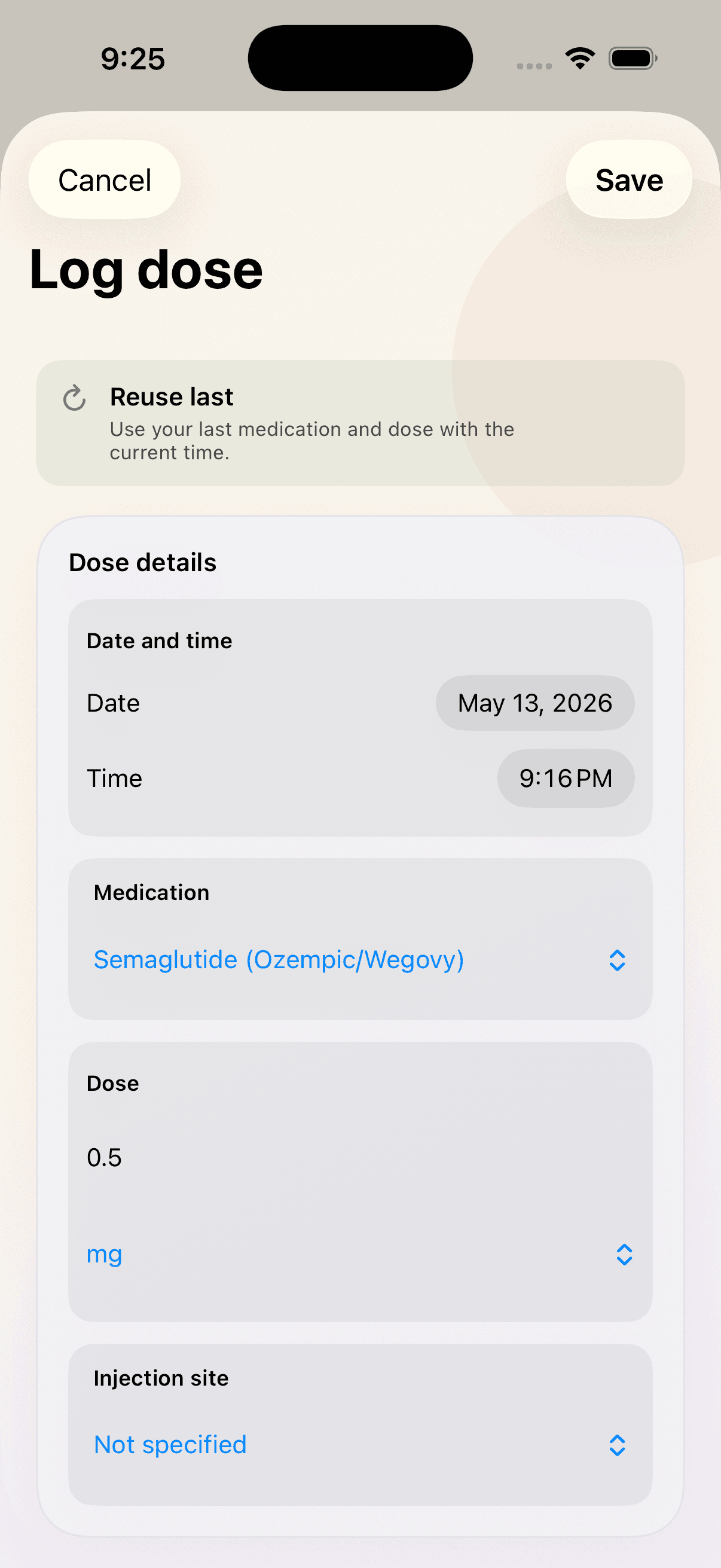
Keep the routine together in Shotz.
Plan, log, and review your routine in one considered iPhone and iPad app.
Download on the App StoreResearch
Sources
Authoritative sources were opened and checked against the health-related statements they support. Product descriptions come from the current Shotz interface and site implementation.
- 1. Create and Keep a Medication List for Your Health — U.S. Food and Drug Administration. The value of a current medication list and the use of clear medication-name and strength information.
Editorially reviewed for clarity, sourcing, product accuracy, and medical boundaries. This article is not medical advice. Read the Shotz Editorial Standards or request a correction at simon@shotzapp.app.
Continue reading
Related guides
A weekly injection-record checklist
A concise, printable-feeling checklist for recording a weekly injection event accurately—without dosing or administration instructions.
Published August 11, 2026 · 4 min read
Appointment prepHow to prepare a medication log for an appointment
A practical way to review a personal medication log, separate recorded facts from observations, and organize questions before a healthcare appointment.
Published August 11, 2026 · 4 min read